Cristiano Godano – steelbloom sessions, in transit between sound and thought
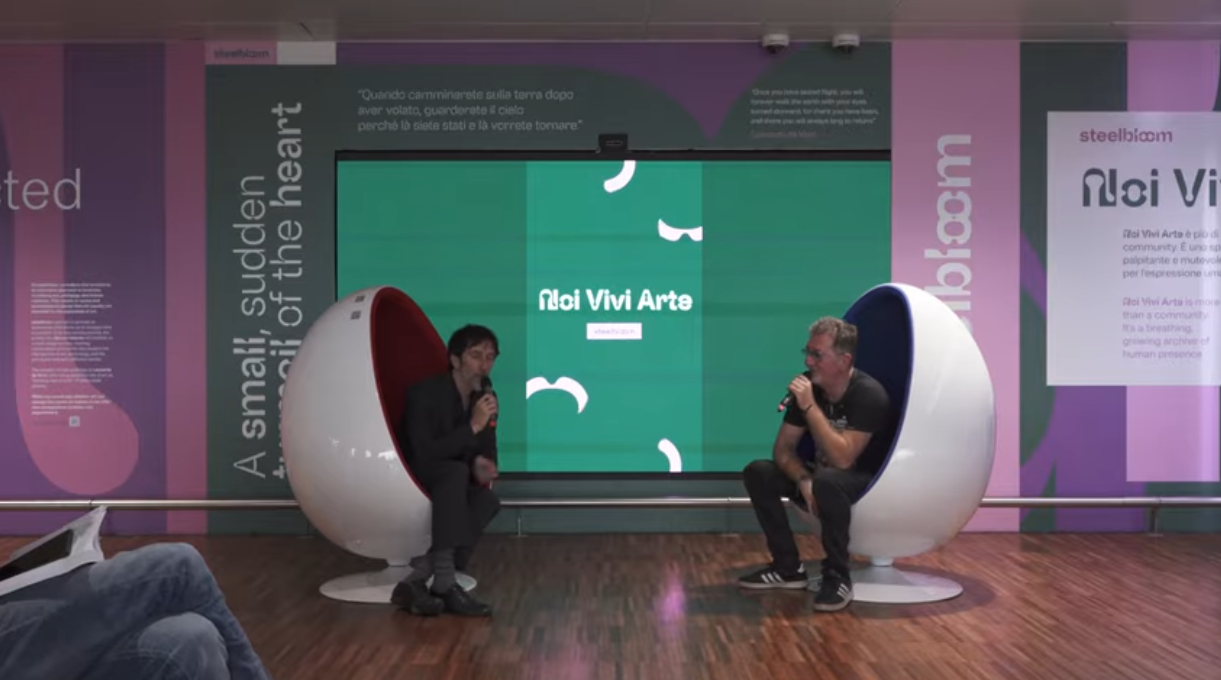
Today, the second episode of the Steebloom Session aired, featuring Cristiano Godano.
There are places we pass through without really stopping: corridors, gates, waiting rooms where time seems suspended and lives brush past each other without meeting. In one of these “non-places”, the steelbloom art area at Milan Bergamo Airport, art collides with travel thanks to steelbloom sessions, the format that brings music and words to the heart of the airport.
It is precisely in one of these ‘non-places’ that steelbloom has chosen to shine a different light, transforming the art area of Milan Bergamo Airport into a space for listening, reflection and shared beauty.
An artist in a “non-place”
Here Gabriele Bròcani meets Cristiano Godano for a conversation that is much more than an interview: it is a shared exploration of fears, thoughts and visions on the meaning of art today.
Sitting in front of the LED wall, surrounded by trolleys and boarding announcements, Godano recounts his ambiguous relationship with flying: he fears aeroplanes, but has learned to experience the airport as a comfort zone, a privileged observatory on lives in transit.
In this scenario, what strikes him is the prevalence of phones over books: many people scroll incessantly, few read, and this image immediately becomes the starting point for talking about words, depth and attention.
The word as a balance between sound and meaning
For Godano, words are not mere vehicles, but living matter to be sculpted with rigour and sensitivity.
In his dialogue with Bròcani, he distinguishes between poetry and song lyrics, but emphasises that both are based on a strong economy of language: few words, chosen with care, which must be necessary, precise and difficult to replace.
For him, writing is a continuous balance between sound and meaning, in which there is no clear hierarchy between music and lyrics: one feeds the other, in a constant dialogue that aims to evoke rather than explain.
When Bròcani reads him a text generated by artificial intelligence “in his style”, Godano notices some superficial similarities, but immediately senses the absence of the “unspoken”: the effort, the discarded attempts, the stratification of experience that accompanies human work are missing.
A good poem, he explains, suggests and opens up spaces, it does not fill all the gaps. He offers no shortcuts to young people who want to write songs: if their thoughts are superficial, their lyrics will be too; to nurture lively writing, you need to read, feed on ideas and broaden your inner horizons.
Music, climate and responsibility in the age of manipulation
The conversation then broadens to the present state of music and society. Bròcani refers to the language that often dominates certain trap scenes, centred on money, possessions and relationships treated in a vulgar manner.
Godano does not present himself as a moralist, but sees music as a mirror of a social context marked by crisis and simplification.
His response, together with Marlene Kuntz, comes in the form of projects such as Karma Clima, an album that tackles the issue of climate change without resorting to preaching or accusatory rhetoric.
For him, the environmental emergency is the biggest problem facing humanity right now, not just for our children or grandchildren.
At the same time, it recognises how limited the impact of individual action is in a system governed by economic interests and by a political class that is often incapable of making radical choices.
In this scenario, he sees collaboration between science and art as a possible way forward: scientists struggle to make themselves heard, while artists can transform data into narratives that can excite and move people.
But for this to happen, greater collective awareness is needed, which is currently undermined by a network that amplifies manipulation, polarisation and slogans.
“Stay by my side”: overcoming anxiety with songs
In the final part of the meeting, the focus shifts to ‘Stammi accanto’ (Stay by my side), Godano’s second solo album. Created in the period immediately following the pandemic, the work is the result of a phase of creative block and intense anxiety about the future.
While many musicians used lockdown to write and produce, he felt paralysed: the suspension of time, the impossibility of playing live, the loss of work opportunities turned that period into a difficult whirlpool to navigate.
Writing the songs on the album was a way to get things moving again, transforming fear and disorientation into poetic material.
His personal story also prompts broader reflection on the condition of musicians: streaming, which has eroded record sales; the economic fragility of the profession; and the paradox of a few large, high-priced stadium events alongside a network of small to medium-sized concerts that are struggling to survive.
In this context, the steelbloom sessions experience at the airport takes on symbolic value: bringing music and thought back to a place of transit means restoring depth to waiting, offering travellers not only entertainment, but also the chance to encounter a voice that questions, narrates and attempts to give shape to the unease of the present.
