 Curioso
 Raffaella Suaria
CuriosoLa Grande Onda di Plastica
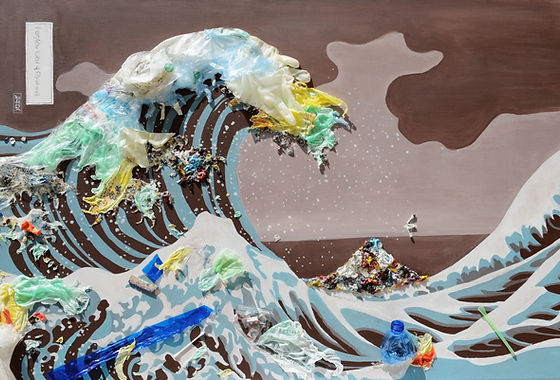
“The Great Plastic Wave”
80 × 120 cm
Mixed media
Plastic pollution today is a true emergency.
A global emergency in which we are all, sadly, protagonists.
The renowned oceanographer Sylvia Earle stated:
“The decisions we make in the next 10 years will determine what life on our planet will be like for the next 10,000.”
A statement as alarming as it is true—yet it is also true that we still have time to change things.
“The Great Wave off Kanagawa,” created between 1829 and 1832 by the master Hokusai (and made famous as the first of the 36 woodblock prints in the series “Thirty-Six Views of Mount Fuji”), is probably the most famous artwork in Japan and undoubtedly one of the most iconic images in the world.
“The Great Plastic Wave” borrows the notoriety of that image, with all its power and recognizability, altering certain aspects and overturning its original meaning.
In this reinterpretation, the focus shifts to the destructive force that humanity inflicts upon nature, rather than the other way around.
The boats and fishermen disappear; Mount Fuji becomes a mountain of waste, over which a seagull flies—also made from discarded material. Replacing the Prussian blue used by the Master are shades of brown, denouncing the terrible transformation our waters are undergoing.
The wave no longer crashes against humanity; instead, with its force, it sweeps away and drags along the plastic waste that suffocates it.
Humans are entirely absent from the scene—the only symbolic element referring to them is a glove looming over the wave, mimicking its “claws.”
Even though humanity is not present, its “hand” is, tragically, the true protagonist and the one responsible.
Rajatsa, 2019
