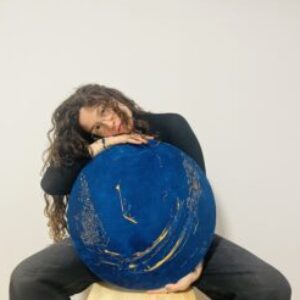
 Curioso
 Matilde Pacchioni
CuriosoBleed
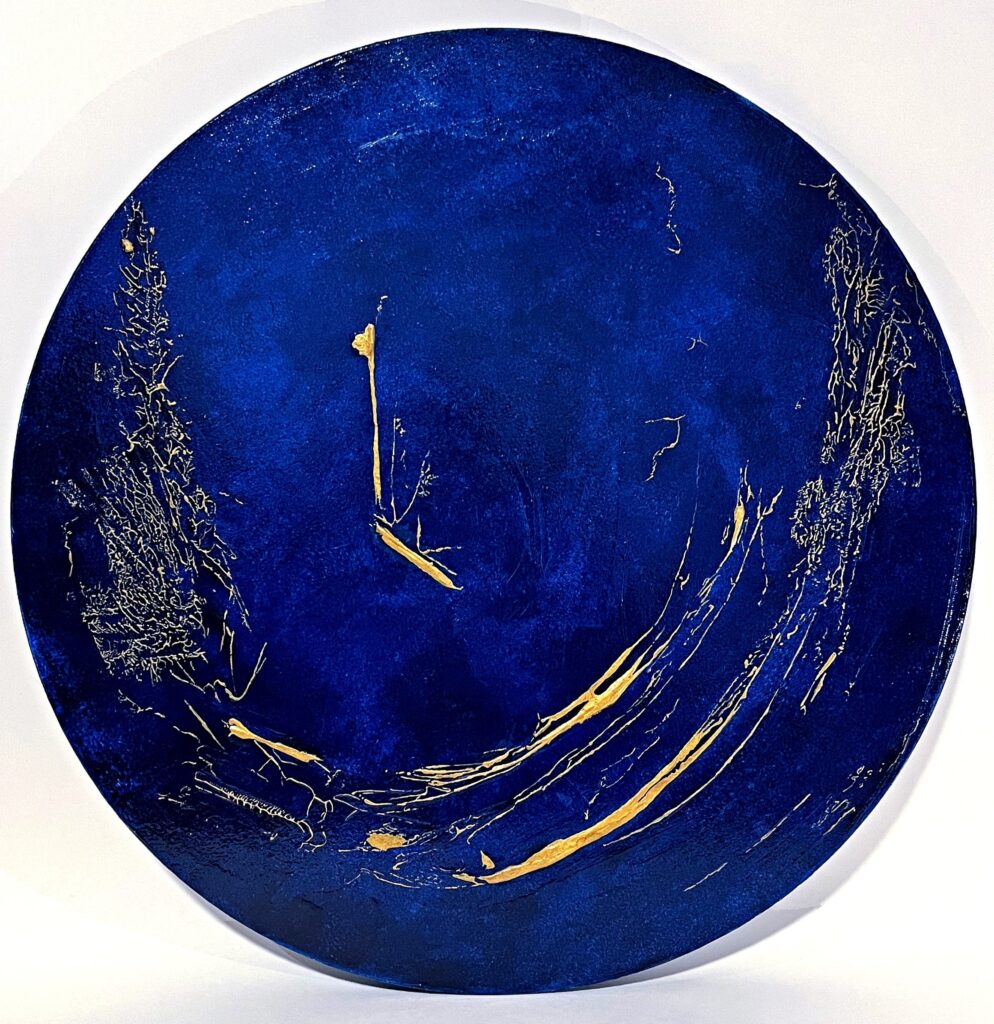
Bleed presents itself as a circular painting that suggests a closed universe, an inner dimension without corners or escape routes, where pain circulates and constantly reproduces itself.
The dominant color is a deep, material blue, evoking melancholy not as a fleeting feeling, but as a state of being. The saturation of the pigment creates a sense of weight and density: it is the blue of the night of the soul, a silence that paradoxically becomes “deafening” precisely because of its vastness. The texture is not flat, suggesting an interiority in constant turmoil.
Gold appears as matter emerging from the wound. The golden veins represent the “fracture.”
The central area marks the exact point of emotional impact, while along the lower edge, the gold accumulates and slides following the curvature of the tondo, directly recalling the title of the work—to bleed—made visible here: it is the painful “blood” of consciousness that does not heal, that continues to flow slowly and inexorably.
The thin, jagged textures on the sides represent the “deafening” aspect of melancholy, that mental buzz that accompanies an open wound. The use of gold suggests that this wound, however painful, defines the person’s value.
Bleed tells the story of a suffering that has found its own rhythm, a wound that, by continuing to bleed gold onto blue, transforms chronic pain into an object of hypnotic contemplation.
