 Curioso
 Ivan Venerucci
CuriosoThe Universe Of Maria Maddalena di Svetlana Nesterova
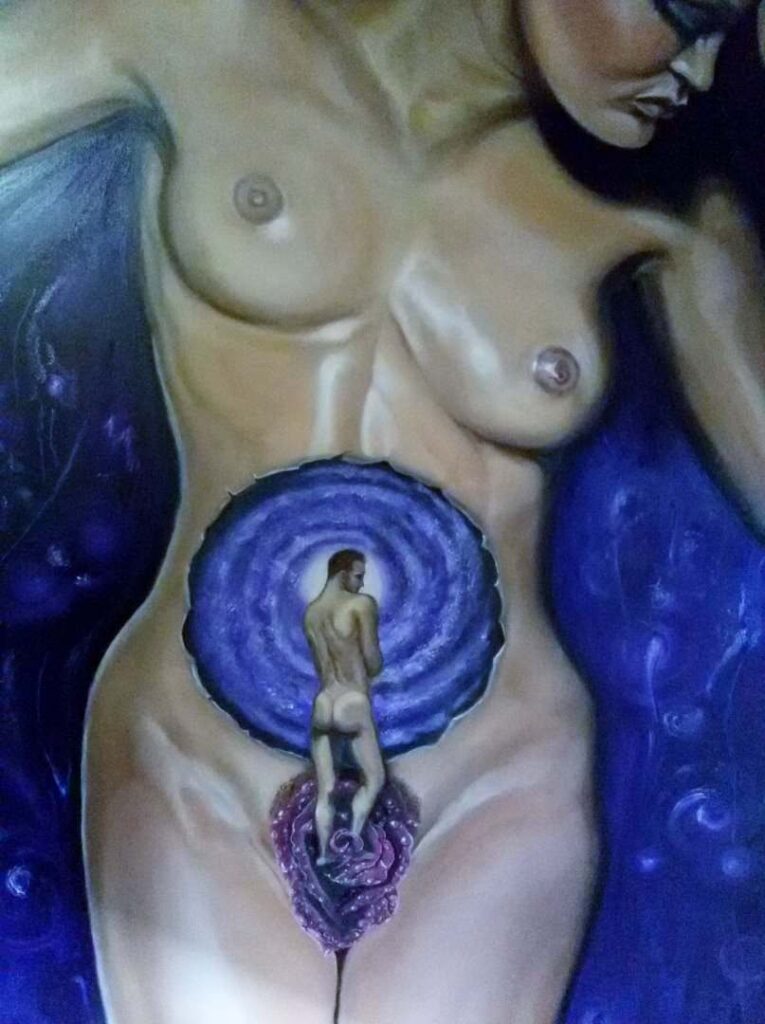
The Universe of Maria Maddalena by Svetlana Nesterova presents itself as a work of strong symbolic and spiritual intensity, positioned within contemporary symbolic surrealism, with clear esoteric and archetypal references. The painting offers a profoundly innovative reinterpretation of the figure of Mary Magdalene, removing her from traditional Christian narrative iconography and elevating her to a universal emblem of feminine consciousness and spiritual transformation.
Composition
The composition is centered on a female figure that emerges as the energetic focal point of the entire scene. Mary Magdalene is not placed within a real or historical space, but within a cosmic and timeless dimension, comparable to a sphere or a universal field. The surrounding environment is not descriptive but evocative: an inner universe where matter, light, and energy merge into a visual continuum.
The compositional structure suggests balance and centeredness. The figure appears integrated into the space that envelops her, not as a separate element but as a constitutive part of the universe itself. This fusion between subject and cosmos reinforces the idea of unity between microcosm and macrocosm.
Color and Light
Color plays a primary role in constructing meaning. The palette is dominated by warm, deep tones—gold, purple, red—combined with luminous blues and light blues. Gold evokes the sacred and transcendent dimension, while purple alludes to inner transformation and emotional depth. The blues expand the perception of space, suggesting infinity and the spiritual realm.
Light is not naturalistic but interior and diffused. It seems to emanate from the figure of Mary Magdalene herself, suggesting a state of illumination or heightened awareness. This luminous treatment reinforces the interpretation of the work as a representation of a spiritual process rather than a narrative scene.
The Figure of Mary Magdalene
Mary Magdalene is depicted as an archetypal figure, free from traditional iconographic attributes. There is no trace of the suffering penitent or the evangelical witness; instead, her presence conveys calm, balance, and inner strength. Her posture is composed and collected, her gaze introspective, directed toward an inner dimension rather than toward the viewer or the external world.
In this interpretation, Magdalene becomes a symbol of the universal feminine principle: bearer of knowledge, healing, and the integration of opposites. She acts as a mediator between matter and spirit, between the earthly dimension and cosmic consciousness.
Symbolism and Meaning
The title itself, The Universe of Maria Maddalena, clarifies the interpretative key of the work: the universe is not conceived as an external space, but as the inner dimension of being. Mary Magdalene embodies a complete spiritual universe, an energetic center where memory, intuition, and transcendence converge.
The artwork suggests a non-dogmatic, open, and inclusive vision of spirituality, in which the sacred figure becomes a universal human archetype. The symbolism is never illustrative but allusive, leaving the viewer free to engage in a contemplative and personal reading.
Style and Language
From a stylistic point of view, the painting combines a refined, layered pictorial technique with a visionary language. Forms are not rigidly defined but seem to emerge and dissolve within the chromatic space, creating a sense of slow, meditative movement. This choice reinforces the suspended and transcendent atmosphere of the work.
Conclusion
The Universe of Maria Maddalena is a work that transcends simple figurative representation to present itself as a visual and spiritual experience. Svetlana Nesterova constructs a powerful and contemporary image of Magdalene, understood as a symbol of awareness, integration, and inner light. The painting invites the viewer to deep contemplation, suggesting that the vastest universe is not the external one, but the one that resides within the human being.
